Sahar Tarighi


"Three Threads of Healing"
Three-Channel Video (Recorded Performance)
2022
Video Credit: Yoosef Mohamadi
Esmer, my mother, once told me a story from her youth in Singan Village. When a respected person passed away, she and her friends, still young girls at the time, cut their braids in mourning. They offered them as symbols of grief, remembrance, and respect. Like Sim in the silent film Zare (1926), they left something deeply personal behind: a part of themselves bound in memory and sorrow. One of Zare’s most powerful scenes depicts this gesture, when Sim cuts her braid and places it on her husband’s grave as an act of grief and devotion.
This three-channel video performance unfolds through the body, the braid, and the land. It was recorded on Indigenous land in what is now Newark, Delaware. The braid functions as a vessel of identity, lineage, and continuity. Its cutting holds both rupture and care, separation and loyalty. Across three channels, referencing the three strands of a braid, my body repeats the actions of combing, braiding, cutting, and leaving. The braid is not discarded but offered, resting on the land as a quiet witness. This work extends my ongoing practice The Warp and Woof of Freedom, where braiding operates as both a material process and a feminist socio-political language.
Film still, Zare (1926)
Directed by Hamo Beknazarian
Silent Armenian–Soviet film portraying the life of Yazidi Kurds in the Caucasus and their resistance to imperial Russian authority.
This still is taken from the scene in which Sim cuts her braids in mourning.
Zare, directed by Hamo Beknazarian, is a silent Soviet–Armenian drama and the first Armenian feature film to center Kurdish life and culture. Set against the backdrop of Mount Ararat during World War I and the twilight of the Tsarist Empire, the story follows Saydo, a young shepherd, and Zare, his beloved. Their quiet village life is shattered by Timur-Bek, a powerful warlord who desires Zare. When she refuses him, a chain of tragic events unfolds—taxation, desertion, kidnapping, and the weight of tribal customs—all leading Zare and Saydo to flee together, in search of love and freedom.
The film is both an ethnographic document and a poetic critique of social structures. It portrays Kurdish (including Yazidi) rural life, illuminating cultural rituals, power dynamics, and emotional landscapes. Starring Maria Tenazi as Zare and Hrachia Nersisyan as Saydo, the film runs approximately 69 minutes and remains a powerful cultural artifact—a century-old lens into Kurdish experience, memory, and resilience.
A Scene of Braided Mourning
One of the most symbolic moments in Zare occurs after the death of Zare’s brother, Surab (Zurba). In a powerful gesture, Surab’s wife, Sim (played by S. Gevorgyan), after the funeral, stands in silent grief, and cuts off her braid, placing it on his gravestone.


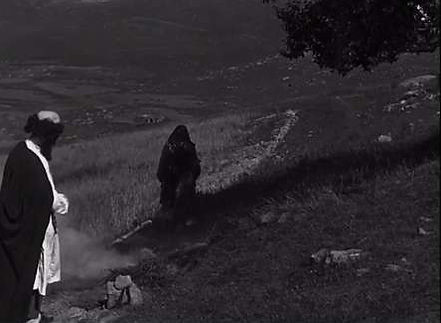

Film still, Zare (1926)


Artist with The Warp and Woof of Freedom
Installation view, Ceramics braids
2022
Photo credit: Yoosef Mohamadi